Why Knowing Your CPU Details Matters
Your phone’s processor type and CPU clock speed directly impact performance, battery life, gaming, and multitasking. Whether you’re troubleshooting lag, evaluating battery drain, or preparing to upgrade, knowing your SoC can help you make informed decisions.
High‑value search keywords: check Android CPU speed, see Android processor type, Android CPU info app, monitor phone CPU frequency.
🔧 Step‑1: Use a Hardware Info App
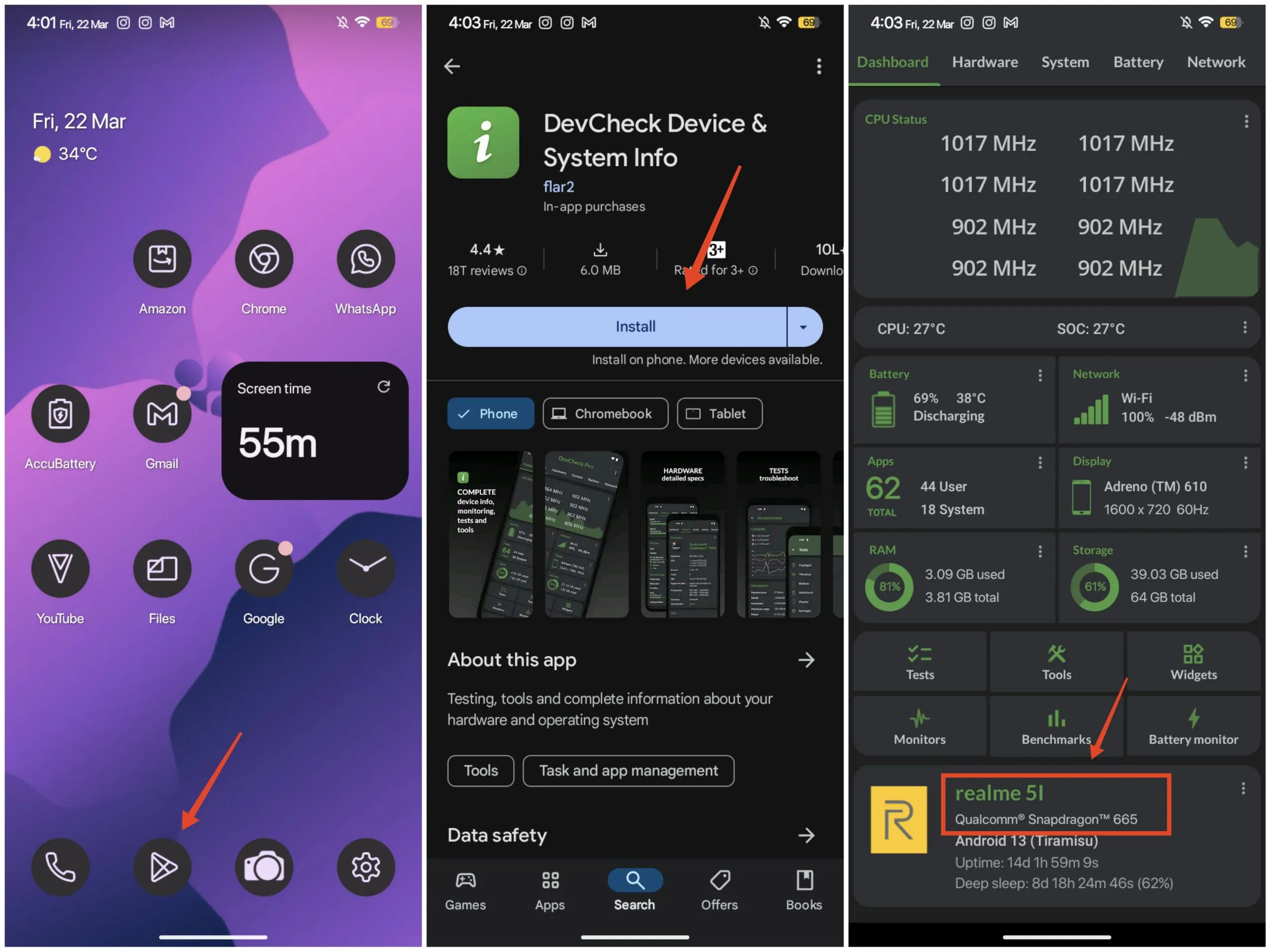
DevCheck is one of the most reliable free apps for Android hardware details:
-
Install DevCheck from Google Play.
-
Open the app and tap the Hardware tab.
-
Under Processor, you’ll find the SoC name, core count, architecture, and real‑time clock speeds.
-
The Dashboard view displays current CPU speed per core How-To GeekReddit+7Phandroid+7How-To Geek+7CPU/GPU Meter App+4Google Play+4YouTube+4.
Alternatively, try CPU‑X or CPU‑Z, which list SoC, each core’s max/min frequencies, RAM, sensors, and battery stats Google Play.
📡 Step‑2: Monitor Real‑Time Frequency & Throttling
If you’re curious about how your CPU behaves under load:
-
Install CPU/GPU Meter & Notification or CPU‑X.
-
These apps run in the background and reveal real‑time clocks and throttling through notifications CPU/GPU Meter App.
Why this matters: Smartphones throttle CPU frequencies to manage heat and battery life. Monitoring frequency ranges helps you understand performance dips.
🛠️ Step‑3: Deeper System Insights (for advanced users)
For those who prefer a tech‑savvy route:
-
Access the Android terminal or root shell.
-
Read files like
/sys/devices/system/cpu/cpu0/cpufreq/cpuinfo_max_freqto find the max allowed speed Wikipedia+4Android Enthusiasts Stack Exchange+4CPU/GPU Meter App+4. -
Use
time_in_statelogs to track frequency usage here Android Enthusiasts Stack Exchange.
This method gives exact numbers in kHz, offering precise data—but most users prefer user‑friendly apps.
🧪 Step‑4: Benchmark & Compare Performance
For benchmarking and comparing:
-
Geekbench 6: Measures single‑ and multi‑core CPU performance. Ideal for comparing across devices Tech Advisor+1Wikipedia+1.
-
GFXBench: Offers deeper insights into GPU and CPU under stress How-To Geek+5Tech Advisor+5Google Play+5.
-
AnTuTu: Delivers holistic scores—including CPU, GPU, memory, and UX—but watch for benchmark optimizations Wikipedia+1YouTube+1.
These tools provide benchmark high‑CPC keywords like Geekbench Android, AnTuTu CPU test, benchmark phone speed test.
📝 Step‑5: Interpret Results & Use Them Smartly
-
If your CPU never reaches advertised speeds under load, overheating or thermal throttling may be the culprit.
-
Underperforming compared to benchmarks? Try disabling background apps, clearing cache, or updating your software.
-
Compare your scores: Search “Geekbench [your CPU model]” to see how you stack up.
Internal/Cross‑linking Suggestions
Link to related posts like “Top Android benchmarking apps in 2025”, “How to prolong mobile CPU lifespan”, or “Thermal throttling explained”.
Headlines & Formatting
-
Use
<h2>headings for steps to boost SEO structure. -
Bold key terms to catch both readers and search engine attention.
-
Include a table or bullet list listing top CPU info apps.
Quick Summary
| Task | Tool or File |
|---|---|
| Identify SoC & CPU info | DevCheck, CPU‑Z, CPU‑X |
| Monitor real‑time frequency | CPU/GPU Meter, CPU‑X notifications |
| Get max CPU speed manually | /sys/devices/.../cpuinfo_max_freq |
| Benchmark performance | Geekbench 6, GFXBench, AnTuTu |
Final Thoughts
By using apps like DevCheck, CPU‑X, and CPU/GPU Meter, you can easily check your Android CPU’s model, clock speeds, and real‑time behavior. For deeper diagnostics, terminal files like cpuinfo_max_freq are useful too. And for understanding performance compared to other devices, tools like Geekbench 6, GFXBench, and AnTuTu are essential.
🔎 Want to expand this guide? Consider adding:
-
A step‑by‑step FAQ section
-
Comparison charts of popular SoCs (Snapdragon, Exynos, Tensor)
-
Advice on optimizing CPU performance and battery life